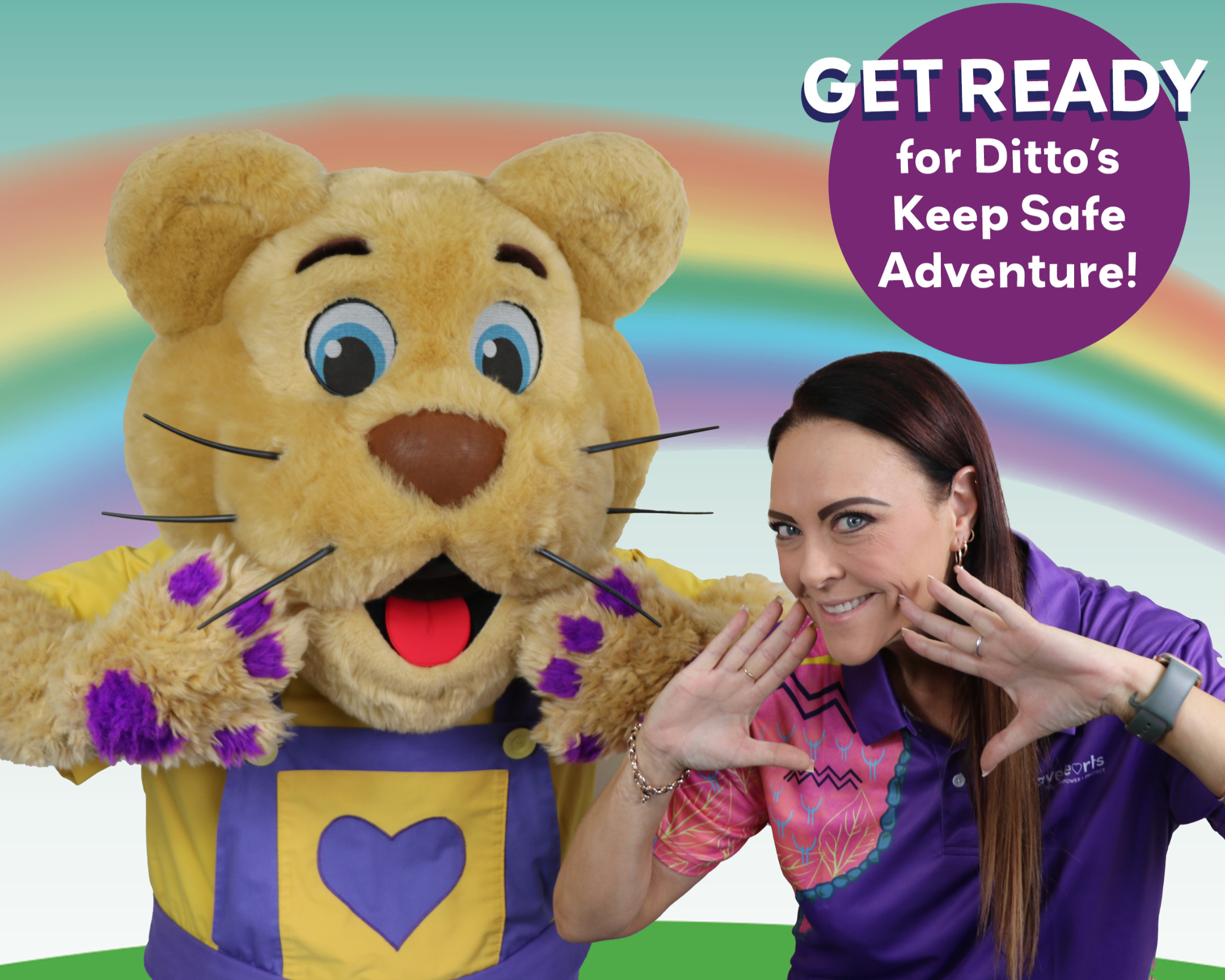
Ditto the lion cub and specially trained educators deliver Ditto’s Keep Safe Adventure program to kids aged 3-8.
8 NOVEMBER 2025. Ditto the lion cub might be best known for songs, dancing, and a very memorable purple heart — but underneath the fun is a program built on decades of child protection research.
Content Warning: This post discusses child sexual abuse statistics and prevention. If this topic raises anything difficult for you, please take care while reading, and know that support is available via Bravehearts' Information and Support Line on 1800 272 831.
Why Ages 3–8?
Why teach personal safety to children this young? The answer lies in when risk is highest. More than half of child sexual abuse cases begin between the ages of 0 and 8 — precisely the age window Ditto's Keep Safe Adventure Program (DKSA) is designed for. Waiting until children are older to introduce these concepts means missing the years when they're most vulnerable.
Three Simple Messages
DKSA doesn't try to teach children everything about safety in one sitting. Instead, it distils the message into three simple, memorable rules that a preschooler can carry with them into everyday life:
We all have the right to feel safe with people.
It's OK to say "NO" if you feel unsafe or unsure.
Nothing is so yucky that you can't tell someone about it.
This simplicity is deliberate. Young children don't process abstract instructions well, but they do remember rhythm, repetition, and story — which is why the messages are delivered through song and interactive performance rather than a lecture. The goal is to let children know that their feelings are valid, that saying no is allowed, and that telling a trusted adult is always safe, no matter what they're told.
Does It Work? The Evidence
In 2011, Bravehearts commissioned independent evaluations of DKSA, involving pre- and post-show testing of hundreds of children across multiple schools.
The results were striking: children showed statistically significant improvements across every measured area, including
recognising the physical "warning signs" of an unsafe situation,
correctly identifying private parts,
telling the difference between a "good" secret and a "bad" one, and
knowing who to talk to if they needed help.
Before seeing the show, most children either answered incorrectly or said they'd "do nothing" if they knew a troubling secret — afterwards, more than 80% could name a concrete action to take, most often citing the show's own message to "run and tell someone you can trust."
Teachers backed this up too: in a survey of over 600 educators who had hosted the program, 97% said it gave children the right tools and language for personal safety, and 98% said they'd recommend it to other schools.
Notably, the evaluation also found that schools that followed up the show with classroom discussion saw the strongest results — a reminder that Ditto's message lands best when the conversation is reinforced afterwards.